
You know, a lot of people don’t seem to realize that the word “fantastic” isn’t always a compliment.
I could suggest a solution to world hunger involving the process of slicing up the moon’s cheese and distributing it among the populace, and someone might say to me, without sarcasm, “That’s a fantastic idea!” However, there would be a considerable chance that by saying “fantastic,” instead of meaning “wonderful” or “brilliant,” he would actually mean “fantastic” as in “far-fetched and impossible.” As such, whenever the word “fantasy” is heard, it often immediately becomes associated with a positive connotation. After all, a fantasy is about something appealing, so it logically follows that we find a certain appeal with the fantasy itself. But there is a dark side to the magic of this word. Despite their personally enticing nature, fantasies can prove to be extremely wasteful—sometimes even dangerous.
Having said this, not all fantasies carry the same amount of risk. Some of these imaginary worlds tend to be relatively harmless. For instance, “fantasy” is commonly known as an artistic genre. Children’s books such as Alice in Wonderland and Harry Potter each take place in a fictional universe where illogical happenings occur and impossible beings exist. The movie industry seems to bring our fantasies to life with its cinematic renditions of Lord of the Rings’s Middle Earth, tree spirits from The Chronicles of Narnia, and the metamorphic baby from The Incredibles. These diversions, while time-consuming, usually pose little or no threat to our well-being, for they are temporary fantasies that come to an end with the book or movie’s conclusion, allowing us to move on.
Other fantasies are more immersive, and consequently, more harmful. Going one step beyond films, video games provide not only the concept of fantastic worlds but an invitation to become part of them. Gamers can sit for countless hours pretending to be the savior of Hyrule or the hero of the Mushroom Kingdom, and if left unchecked, their outward identities fuse with that of their virtual avatars, forming a single entity within their minds. A hard-core player considers himself primarily to be Link or Mario, while his real life becomes a secondary existence in a lesser, undesirable world.
Another type of fantasy involves what is frequently called daydreaming. Becoming lost in his own mind, the daydreamer visualizes himself under ideal circumstances and often wishes desperately for his vision to become reality. What does the daydreamer see? The possibilities are endless.
One potential daydream is what I like to call the “shining knight syndrome,” where the fantasizer perceives himself doing something heroic such as slaying a dragon, overthrowing a corrupt establishment, or rescuing a damsel in distress.
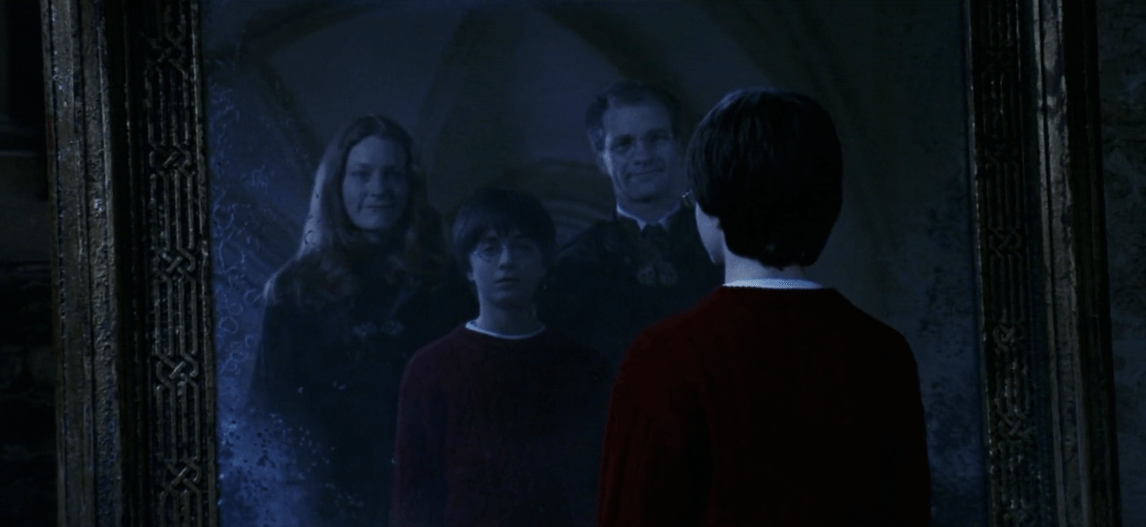
There is also the vision of self-perfection, similar to Harry Potter gazing at his reflection in the Mirror of Erised as he most passionately desires himself to be. In the same way, the daydreamer pictures himself with the best imaginable appearance, the most valuable possessions, and the greatest accomplishments.
But the most powerfully alluring and potentially obsessive daydreams are those of a romantic or sexual nature. Whether it be an unquenchable love for Justin Timberlake or a deep infatuation with a girl who acts like the daydreamer is invisible, the realm of fantasy provides an outlet for these pent-up emotions where even the most ridiculous of pairings can become feasible. The problem is, dwelling excessively upon such fantasies can lead the daydreamer to an irrational state wherein he has foolishly convinced himself that his vision can actually be realized.
But fantasies do not promise possibility. A vision with the potential of success falls more along the lines of a dream. Though they may seem synonymous with fantasies, dreams possess the instrumental quality of hope. We would never have remembered Martin Luther King Jr.’s immortalized speech had he declared, “I have a fantasy.” The dream of an aspirant becomes a goal rather than a wish. It becomes a source of motivation, of inspiration. A fantasy, on the other hand, is something a person yearns for but knows he can never have. It uses fanciful ideas to fill in the gaps where he finds his life lacking, creating an illusion of happiness and control. A fantasy becomes a place of immaterial refuge, an escape for those who would rather not face reality—though, of course, all of us must do so eventually.
It therefore becomes conceivable that over-fantasizing can result in a number of nasty consequences. The first is almost absolute: fantasies waste time. Even the most innocent Disney movie or round of Mario Kart irrevocably sucks away hours of human life—time that might have been put to better use but is now lost. Daydreaming, like staring into the Mirror of Erised, can be done indefinitely without having anything to show for it. Moreover, video games in particular are renowned for their tendency to become an addictive habit. There will always be one more secret to unlock; one more golden banana to collect; one more rank of Ultimate Dragon-Mage-Warrior-Hero-Master to reach; one more online opponent to defeat. It never ends.
In addition, fantasies are devoid of hope, and therefore deprive people of it. Without any chance of true success, the fantasizer’s pleasure is derived solely from the idea of success. A man’s fantasies become not just an escape, but a permanent escape. No longer considering personal fulfillment through his actions to be within his grasp, his moments of greatest excitement consist of those when he is most deeply aloof of reality. What a tragic loss of life’s opportunities. What a sad way to live in this world: by pretending to live in another.
So in order to avoid this fantastic fanaticism, what must we do? Abstain from fantasy-related activities altogether? Not necessarily. Reading Harry Potter or seeing The Incredibles won’t likely drive us insane. But maybe it would be wise to tone it down a bit. Limit the hours we spend ruling over imaginary kingdoms. Decide that watching all of Star Wars eleven times in the last week was probably enough. Remind ourselves that wishful thinking is all in our heads. And for God’s sake, remove all of those obscene Zac Efron posters from your locker.
 The Commonplace Notebook