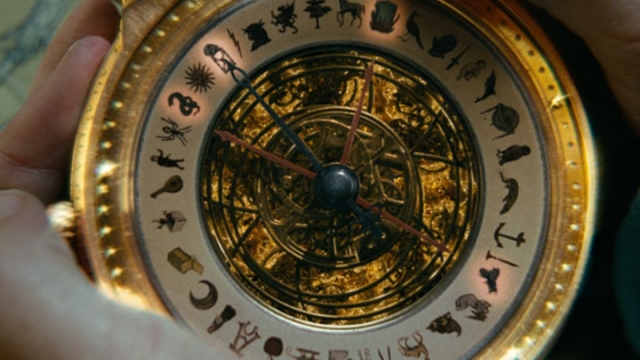
In 2007, a film adaptation of Philip Pullman’s The Golden Compass sparked a controversy that should never have happened. Critics condemned it for portraying religion—the Catholic Church especially—in a negative light. I’ve heard warnings ranging from its atheistic agenda to its being a story about two children who “kill God.”
Well, I want to explain why these widespread rumors are, frankly, trash—and how the sort of passive publicity that led to its condemnation has become dangerous not just to good storytelling but to the entire realm of human learning.
One might ask, “Alex, why are you bringing this up after almost 10 years?” At first this topic might seem irrelevant to today’s world, which has long since moved past the film lore of the previous decade. However, it is precisely because of this time lapse that I feel moved to vindicate The Golden Compass. Even after years and years—after the internet and my friends and even my seminary teacher cautioned against its blasphemous content, after the film was okay but not good enough to warrant a sequel, and after the entire series, His Dark Materials, has gathered dust on a shelf in my attic—still this literary injustice continues to bother me.
I’ll start with the logical fallacy that plagued these critics. Francis Bacon (stay with me), in the 17th century, revolutionized scientific theory by advocating a shift from “deductive” to “inductive” reasoning. In a nutshell, deduction involves testing specific things based on preexisting assumptions. Induction, on the other hand, falls more in line with what science means to us today: to test a wide variety of samples, and based on those collective observations, to draw a conclusion about some overarching principle that explains the data.
This difference between deduction and induction is precisely what contributed to The Golden Compass’s ill repute. Most of the critics have never even read the books; those who did noticed that the primary antagonist was, indeed, a religious organization. They deduced that since Pullman is personally an atheist, he was using these characters to attack all religions and religious organizations in general.
See the problem here? Assuming that the inclusion of a religious villain constitutes an assault on religion itself would be like inferring that since the book contains a villainous polar bear, Pullman therefore believes and advocates that all polar bears are evil (and even then, many of the other polar bears in the novel were of commendable character). Why Bacon’s logic still hasn’t transferred from science to literature for almost four centuries is beyond me.
But wait—there’s more! Some critics who read the series in its entirety claim it is a story about children killing God. I don’t know what bone these people had to pick with the author, but here’s the reality of it (slight spoilers): God is not even a character in these books. There is a really old angel called The Authority who sort of pretends to be God, but he is so old that he must be contained in a crystal box to remain intact. His highest-ranking angel essentially keeps him as a powerless figurehead and takes control over the angelic armies himself. At one point, The Authority’s box is mishandled in transit and harassed by vulture-like creatures. The two child protagonists, Will and Lyra, drive away the creatures and attempt to free The Authority from his crystal prison, but in doing so they cause him to peacefully disintegrate from exposure to the outside world.
Pretty sinister, right?
So I suppose my beef with The Golden Compass’s defamation is twofold: the illogical deductive reasoning used to label it as “anti-Christian,” and the bandwagon mentality that if a bunch of people are saying something about the book, it must be unequivocally true.
As for the latter issue, I would think that Mormons, of all people, would be understanding. How do we feel when people refuse to even consider reading The Book of Mormon just because their preacher or anti-Mormon acquaintance told them not to? Certainly, immersing ourselves too much in questionable material can be spiritually dangerous, but that doesn’t mean any piece of writing that doesn’t conform to our theology is damning or incapable of uplifting us.
To me, the controversy over The Golden Compass was every bit as ludicrous as the people who burned and banned the Harry Potter series on the premise that it portrayed witchcraft in a positive light. There is literally no rhetorical difference between the two. Can religious figures and institutions become corrupt? You’d better believe it. Can an obsession with arcane metaphysical arts rip your soul into shreds? Clearly it can. Does that mean that one piece accurately represents the whole? I sure hope not; otherwise, I would be equal to the worst Mormon who ever lived.
Having read the books, I say with confidence that His Dark Materials has had a positive spiritual impact on my life. For me, the series is not so much about toppling corrupt religious establishments as it is about human nature. It suggests that “original sin” does not in fact tarnish our souls with guilt from birth; rather, mankind is inherently good but lives in a corruptible world. “Original sin,” or “Dust” or “Dark Matter” or whatever you want to call it, is an artifice of man. I certainly hope my fellow members of the Church do not see this as out of harmony with the Gospel.
I hope that by recognizing this example of a great work grossly misrepresented, we will proceed with more caution when adopting others’ opinions of things we haven’t experienced ourselves. I hope that in our quest to make judicious, moral decisions about what we read, watch, and listen to, we will not overcorrect so much as to be overly dismissive of many things that might enrich our souls. I hope we will apply sound inductive reasoning before forming judgments about an author’s entire corpus of works. And I hope we will learn how to extract gems of truth and beauty out of all the ideas around us even if we don’t agree with every tiny detail of them.
Whether your guide is Lyra’s truth-telling alethiometer (the “golden compass”) or Lehi’s Liahona, we are all pursuing the same treasure: knowledge.
 The Commonplace Notebook