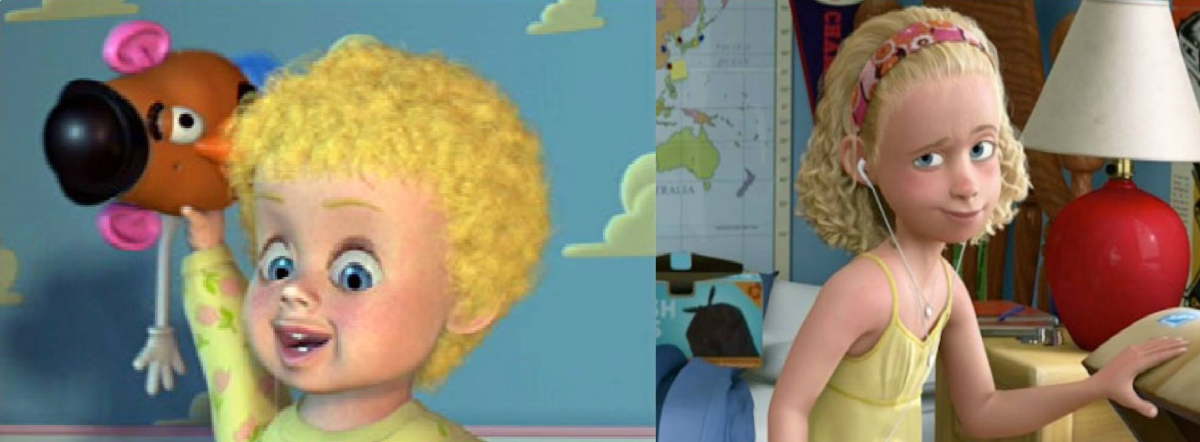
Super Carlin Brothers has already made a video exploring possible villains for The Incredibles 2…but not for Toy Story 4. After careful watching and unexpected inspiration, I’ve developed a surprisingly solid theory about the identity of the villain of this final installment. But it will require some explaining.
To begin with, let’s take a look the Toy Story antagonists as we’ve seen them thus far:
–Toy Story—Human (Sid) and, arguably, Toy (Mr. Potato Head)
–Toy Story 2—Human and Toy (Al and Stinky Pete)
–Toy Story 3—Toy (Lotso)
–Toy Story 4—With this heavy concentration of toy villains, it seems reasonable to expect that the time has come for another human villain.
Now, we know the premise of Toy Story 4 will be Buzz and Woody searching for Bo Peep, but…why and how was she lost?
Before we attempt to answer this, let’s go back to the beginning. We know that in the Toy Story world, all toys must follow the rule of secrecy—that is, no matter what, their ability to come to life must remain hidden from humans, even those they care most about such as Andy.
Woody and the mutant toys revealed themselves to Sid, but only because they knew no one would believe his story after he freaked out about it.
No other human in Toy Story knew that toys could come to life, right?
Wrong!
While listening to Hakuna Matata in the car, Molly watches Buzz and Woody in the car’s side mirror as they ride RC down the street in pursuit of the moving van.
While it could be argued that no child of Molly’s age (around 2?) would retain memories when they’re so young, humans are in fact capable of retaining occasional images from a very early age, especially significant ones (for instance, I have vague impressions of being on an airplane doing a puzzle when I was 2). And I’d say discovering that toys come to life very much qualifies as a significant memory that she could at least retain a vague visual memory of. Even if her childish brain easily accepted living toys as a natural fact, it would still be an interesting enough image to become a “core memory,” or at least a long-term memory, of sorts.
So we have Toy Story 2. Neither Andy nor Molly are much older than they were in the original, so Andy’s sister is still unlikely to be capable of doing much of note; but the older she gets, the more solidified her memories become. And she has opportunities to see things no one else does, such as Woody riding Buster to rescue Wheezy from the yard sale. Though the cowboy is careful to ensure Andy’s mom and the humans outside catch no sight of him, he does not think of Molly’s bedroom window, through which she could easily have seen everything that went on in her driveway below.
Thus, as Toy Story 2 ends and time begins to elapse between the second and third movies, Molly has witnessed toys come to life on at least one occasion, probably two, possibly many more, considering the toys don’t seem to be as concerned about hiding themselves from her than from Andy or his mom or other humans. And just as important, she’s witnessed toys going to great lengths to help each other stay together—from being strapped to rockets to riding RC down busy streets away from bloodthirsty dogs to risking exposure at a yard sale. And lest we forget, as Big Al takes Woody away, Buzz Lightyear makes a bold attempt to save him, jumping onto a moving vehicle and being thrown off when he opens the car’s trunk. All of this was fair game for Molly’s eyes.
What would you do in her situation? You’re a growing child whose imagination is probably as wild as any other’s, yet unlike any other child, you know for a fact that toys can come to life! Should you dare to reveal your experiences, you will be dismissed and ridiculed for such childish imaginings. Your only choice is to remain quiet for the approximately ten years during which Andy becomes old enough for college. There is no way your story will ever be believed.
Or is there?
Suppose that Molly isn’t our average child of unremarkable intelligence. Suppose that she is, in fact, significantly smarter than her brother and mother—a genius, even. Even without too ridiculous of an intellectual advantage, a 12- or 13-year-old would be more than capable of concocting a scheme to get what she wants. And in this case, what Molly wants desperately, more than anything else, is for her story to be believed, for her secret knowledge to be validated by the world around her. She wants the world to know and accept that she isn’t insane, and without us even considering the potential for all kinds of exploitation of living toys that such a revelation would present (financial, social, political, etc.), the need to be accepted in this way provides more than enough motivation to go to absolutely any length to prove her secret to the world. There is nothing she wouldn’t do…
…not even, for instance, kidnapping toys or putting them in danger.
Now, you might be thinking, why doesn’t she just videotape Andy’s toys in his room and post it on the internet, or send it to the media or the government?
Well, for one thing, animation can very easily be faked in our day and age. People would be as skeptical of toys coming to life in a bedroom on Youtube as they would be of a Photoshopped bear riding a bicycle.
And for another, with toys’ high prioritization of their rule of secrecy, it’s unlikely they’re unaware of recording devices such as security cameras or voice recorders. No, Woody and his gang are bound to be wary of anything that might leave evidence of their animated existence—if it might lead to their exposure.
The last part of that sentence is key, for it’s actually fairly likely the toys have been caught on camera in the past. Even if there somehow weren’t cameras at a gas station or in a daycare center, there’s absolutely no way an airport’s security feed or the cameras in Al’s Toy Barn wouldn’t have captured the toys in action at some point. But here’s the thing: Security footage is only incriminating if it is used. The vast majority of recorded footage is left unwatched unless there’s been some kind of suspicious activity or stolen property. Other than a few knocked-over toy shelves, none of the toys’ escapades ever gave cause for the humans to question things enough to actually view such footage. Thus, even with modern human technology, the toys have been able to remain hidden from the world—as a living community, at least.
That said, what if someone were looking specifically for evidence of toys coming alive? What if Molly found a way to force Woody, Buzz, and the others to expose themselves to the world?
Yes. This means that Molly is the one responsible for the disappearance of Bo Peep, perhaps of Etch and Wheezy and others as well. We are given no details about what happened to these mysteriously missing toys except that, as Woody says, “we’ve lost friends along the way.” We hear this and assume that they were given away to new owners or sold or something. But if Molly were to take Bo Peep and pretend she’d been given away, who’d know the difference? Not Andy, for remember, Bo Peep was one of the few toys that actually belonged to Molly, and besides, by the time Toy Story 3 rolls around, he’s long since stopped taking regular inventory of his toys.
Also, pay attention to how obsessed Molly is about getting into Andy’s room in the following exchanges:
Andy: So, you gonna miss me when I’m gone?
Molly: If I say no, do I still get your room?
Andy: [they walk down the stairs] Nope.
Molly: Then, yes, I’ll miss you.
***
Andy: Molly! Stay out of my room!
Molly: I wasn’t in your room!
Andy: Then who was messing with my stuff?
***
Molly: Why do you still have these toys?
Andy: Molly, out of my room!
Molly: Three more days and it’s mine!
Clearly Molly stakes great importance on gaining possession of Andy’s old room (and, thereby, his old toys who she knows can come to life). What seem like cute, innocent tween interchanges subtly hint at a deeper motive–one that requires control over Andy’s toys.
So assuming Molly does take Bo Peep, we then have the events of Toy Story 3. Woody, Buzz, and co. are taken to the daycare and topple the tyranny of Lotso. But even with the film’s seemingly perfect, emotionally powerful ending, with Andy saying goodbye to his toys and the gang finding new purpose in their new owner, Bonnie, something still isn’t quite right. Wasn’t the whole point of the movie that the toys ought to stay together at all costs because they’re family? For that matter, wasn’t that the point of all three movies? Why was the tagline for movie posters “No toy left behind,” and the final catchy Randy Newman song called “We Belong Together,” if in the end, they really aren’t all together? That, my friends, is the genius of Toy Story 4, to address this final unresolved issue—only, Woody and Buzz may find that the task ahead of them will be much more perilous, and run much deeper, than they could have ever imagined.
Knowing the toys will do anything to help their friend, Molly bides her time until Andy is out of the picture, then makes her move. She finds an indirect way of giving Woody some sort of clue that will lead them on the trail to Bo Peep. They follow it. And finally, they end up in some sort of environment where there are many, many humans—perhaps a school or a theater or an expo of some kind. Molly has Bo Peep in a predicament ironically reminiscent of Andy’s playtime damsel-in-distress scenarios. Woody and Buzz are presented with a choice: Reveal themselves to the world…or watch Bo Peep die.
Now, you might counter, did the creators of Toy Story really plot an entire 4-movie saga from the very beginning and include tiny hints of Molly’s future throughout the series? My opinion: probably not. But if I was John Lasseter or Pete Docter, and I was rewatching my films, I do think I might notice these details, and I might realize that by pulling on these unintended strings, a whole new story that links them all together could appear. So even though this is all “speculation” and assuming connections between all the previous movies that weren’t all necessarily planned, I do think these plot points to be very realistic and legitimate possibilities.
Most of us questioned Disney-Pixar’s decision to continue the Toy Story series with a fourth installment, particularly because the third one seemed to make such a perfect ending. But if I’ve learned anything from watching Pixar, it’s that when they make a film, there’s a story worth telling—nay, a story that needs to be told (with the possible exception of Cars 2, which was probably concocted while high on hallucinogenic drugs and then ratified for production on a dare). I’m confident Pixar will once again prove themselves with Toy Story 4. Buzz and Jessie’s love story is complete, but Woody’s is left woefully incomplete without the girl who stood by his side through thick and thin, even when everyone else accused him of murder.
Only, I have a feeling there’s more to this sequel than Pixar’s letting on. I have a feeling that contrary to the words of the nursery rhyme our leading lady is based on, Bo Peep will play the lost sheep in this tale—and she will be guarded by perhaps the most devious, self-driven, unexpected wolf we’ve ever seen.
***
This theory may not have ended up in the actual Toy Story 4 movie that was released in 2019, but it was nevertheless a fun mental exercise of a theory that I still think would’ve made a more interesting story. For my response on the sequel, see this article on why its ending is even better than Toy Story 3‘s.
 The Commonplace Notebook
One thought on “Pixar Theory: The Toy Story 4 Villain Will Be…Molly?”