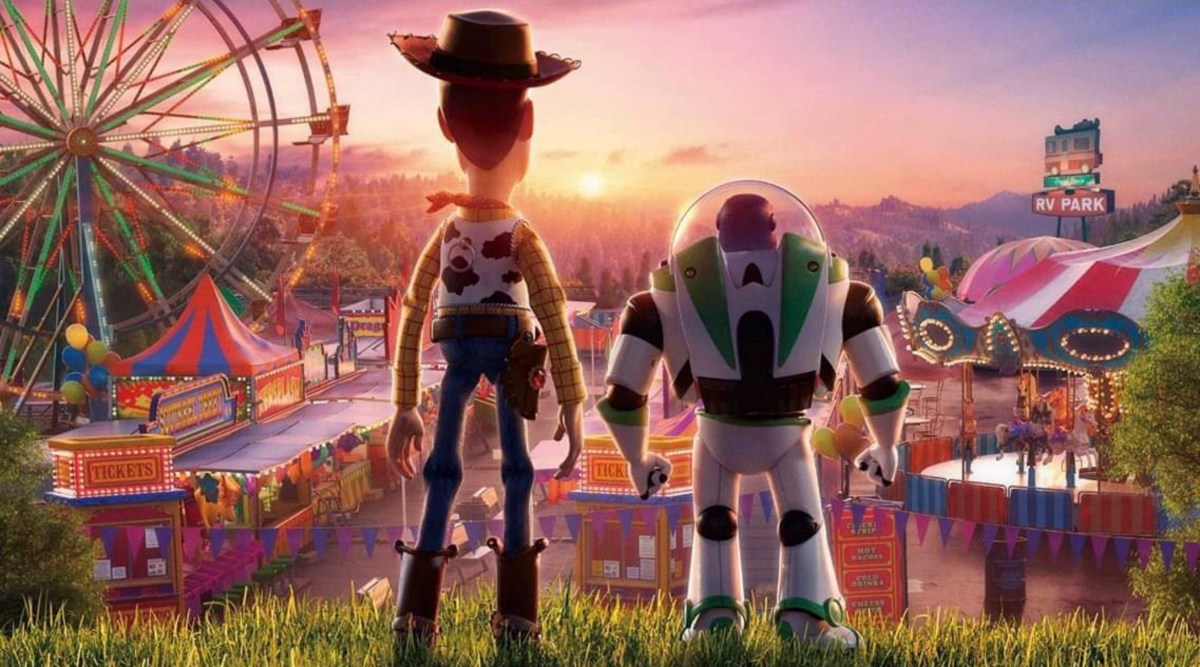
It’s been long enough since Toy Story 4 released that I feel comfortable openly discussing its somewhat controversial ending. And now I am here to explain my somewhat unpopular opinion:
Toy Story 4‘s ending is BETTER than Toy Story 3‘s.
Honestly, watching Toy Story 4 the first time threw me into a sort of Toy Story existential crisis for weeks. Either everything I thought I knew about the Toy Story world was a lie, or else Toy Story 4 was a horrible deviation from the previous film’s “perfect” resolution.
So I can understand why many people dislike what Toy Story 4 did—having Woody part ways with Buzz and the rest in order to be with Bo Peep and remain ownerless. In fact, in terms of the movie itself, I had some minor concerns that made me enjoy it a bit less than the other three, but that’s a discussion for another time.
Firstly, part of the overall theme of Toy Story appears to be how toys find fulfillment and live meaningful lives. And for the first two films, that purpose seems to be clear: To stick together as a “toy family” of sorts and, above all, to remain with and be loyal to their singular child owner, in their case Andy.
Indeed, if the series were to have ended with Toy Story 2, I would see no outstanding existential issues. Sure, kids would grow old as the Prospector points out, and Jesse’s old owner Emily (probably Andy’s mom—another long story) did give her away, but as long as Woody and the others were all there for Andy when he needed them—whether in his toy box, or with his future children, or even stored in the attic—then their purpose would be fulfilled. As Woody says of being there for Andy growing up, “I wouldn’t miss it for the world!”
But then Toy Story 3 comes along and throws a few wrenches into the mix. For one thing, Woody and the gang have “lost some friends along the way”—RC, Etch, Weezy, Bo Peep, etc. This would seem to contradict the previous movies’ assertion that staying together was an essential part of their happiness. “As the years go by, our friendship will never die.” “We belong together” is the concluding song of Toy Story 3, implying that Woody and Buzz and the rest of Andy’s toys can still find happiness since they’re together with their new owner, Bonnie.
But…ARE they all together?
The answer is an unequivocal NO.
In addition to the other toys listed above who apparently went to new owners, several toys WILLINGLY left Andy (or Molly) to stay at Sunnyside Daycare. Yes, Sunnyside was a terrible social pyramid under Lotso’s tyranny, but as Ken asserts, “Sunnyside could be cool and groovy if we treated each other fair!” Clearly, toys like Ken and Barbie and the Army Men were able to find happiness without Andy—or even without a single owner like Bonnie. They were even able to find happiness separated from the rest of their “toy family.”
So, what of a toy’s purpose, then?
We get the clearest statement of this in Toy Story 4 from Gabby Gabby, one that even Woody agrees with: “Being there for a child is the most noble thing a toy can do.”
Not being there for “the” child—just “a” child. In other words, a toy’s purpose is to help make children happy. As important as Woody was to Andy’s childhood, this is the harsh truth: He owes NOTHING to Bonnie. And as sad and hard as it might be, this noble purpose has nothing to do with staying with a particular set of toys forever.
Knowing all this, I can only conclude that the ending of Toy Story 3, as perfect and closure-filled as everyone (me included) thought at the time, is FAKE. It is UNREALISTIC both for this fictional toy world and for the changes we experience in real life as human beings. It does not address the inevitable problem of what to do once Bonnie grows old as well. Will Woody and the gang continue to slowly be siphoned away to new owners until they end up alone and utterly miserable and unfulfilled?
Unless there is more to their purpose than staying together as a “toy family” for a single child, then that is the fate the pattern of Andy’s childhood would lead to. “We Belong Together,” as nice of a sentiment as it is, does NOT mean these specific toys belong together under a single child. If anything, it means that toys and children belong together generally in order to bring each other happiness–even under the various imperfect circumstances depicted throughout the series. Imperfect circumstances are the REALITY for both the toy world and our own, and Toy Story 3 does not address that reality in a satisfactory way.
This problem alone justifies the need for Toy Story 4. Bo Peep, one of the most important people in Woody’s life, is gone, and it is clear that her absence is a hole much bigger than a new owner like Bonnie could possibly fill. Most of us consider keeping couples like the Potato Heads, and Ken and Barbie, and Buzz and Jesse together to be a high priority for their happiness, so why would Woody and Bo be an exception? They are not.
In sum, Toy Story 4 resolves all the underlying complications left hanging by Toy Story 3. Woody and Bo Peep can be together. RC and Weezy and Etch can still find happiness with new owners, because to “belong together” is not exclusive to Woody or Buzz or any toy remaining with a particular child.
And Woody’s greatest purpose and asset is NOT that he’s good at being a fun toy to play with. This is made clear many times: He can be broken, overshadowed, or even replaced. And yes, his loyalty to Andy is admirable, but it’s only important when Andy needs him. When Andy no longer needs him, Woody HIMSELF is the one who chooses to part ways.
We learn in Toy Story 4 that Woody’s greatest strength is to be there when ANYONE needs him—human or toy. He leaves NO ONE behind who is in need of his company. He is a MENTOR for Forky and a FRIEND to help lost or confused toys find purpose. And these skills can be put to no greater use than what we see at Toy Story 4‘s end: to help other toys find children to make happy. it is very much a “teach a man to fish”-type situation.
Though Woody no longer has a single owner, he and Bo Peep and Bunny and Ducky will by no means cease to be played with by children at the carnival and probably in many other future settings. But he will serve as a guide to bring MANY toys and MANY children together. That’s what makes him special, and it is a more noble path than remaining with any single child or any single group of toys in the long term.
The “Toy’s Story” is not a smooth progression from one owner and group of fellow toys to another. It is an allegory of the messy relationships and paths we all experience, in spite of our idealistic hopes and expectations. And if you can’t see that Toy Story 4 conveys that message much more completely than its predecessor ever did, then you’re missing the point!
***
As a side note, many of the points covered in this post connect closely to an alternate plot for Toy Story 4 I wrote. Here I posit a premise I still consider superior in which Andy’s sister, Molly, serves as the compelling villain.
 The Commonplace Notebook
One thought on “Why Toy Story 4 Has the Superior Ending”